📖 Contents
- Part 1: The Avatar Parallel
- ↳ Neural Link = Semantic Address
- ↳ Tree of Souls = Consent Ledger
- ↳ "I See You" = Verified Identity
- Part 2: The Postal Service Analogy
- ↳ The Problem with Dumb Addresses
- ↳ RPP as Smart Shipping Labels
- Part 3: Case Studies
- ↳ Healthcare Data Sharing
- ↳ AI Agent Acting on Your Behalf
- Part 4: Domain Translations
- ↳ How to Explain RPP to Different Audiences
- Part 5: Deeper Philosophy
- ↳ Where Does This Belong?
The Avatar Parallel
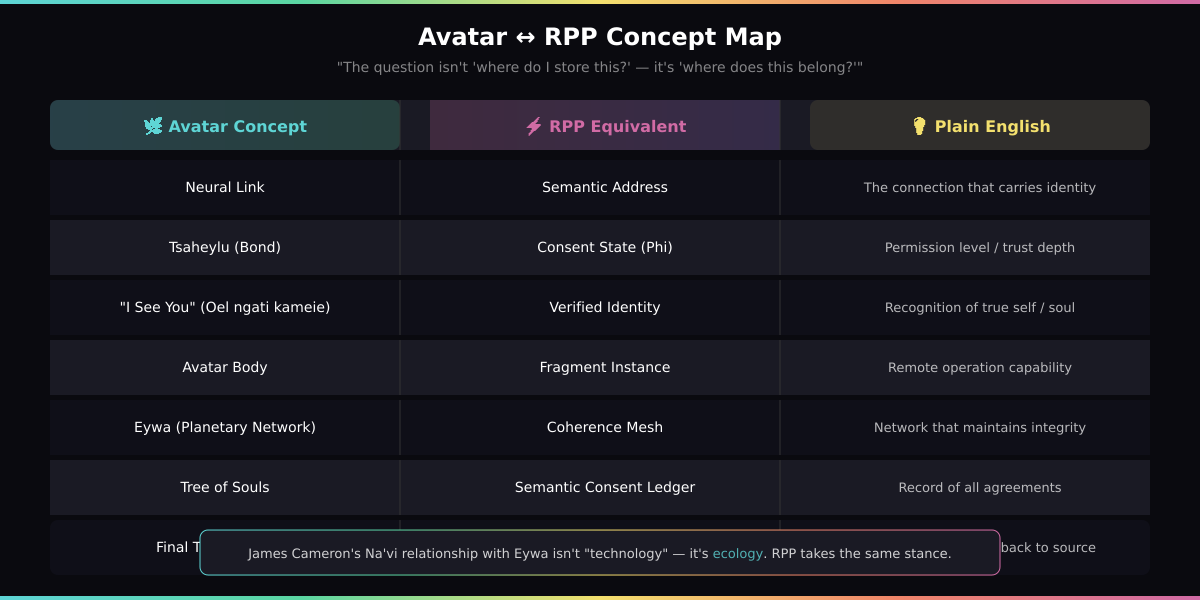
The connection between James Cameron's Avatar and RPP is striking once you see it. The Na'vi relationship with Eywa isn't "technology" to them—it's ecology. RPP takes the same stance toward data.
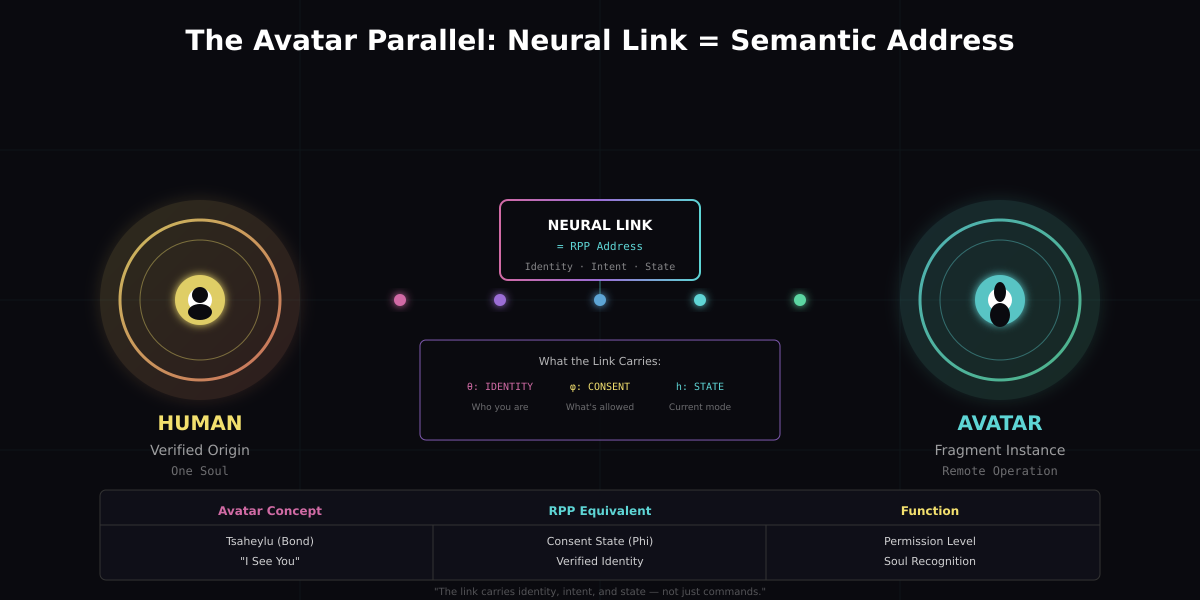
Neural Link = RPP Addressing
In Avatar, humans don't just "remote control" their Avatar bodies. They establish a neural link where:
- One human consciousness connects to one Avatar body
- The link carries identity, intent, and state—not just commands
- When Jake Sully is stressed or exhausted, the Avatar reflects that state
- The connection can be severed, threatened, or transferred
This is exactly what RPP does for data. The address carries meaning, consent, and context—not just location.
Tree of Souls = The Consent Ledger
In Avatar, the Tree of Souls holds the memories and connections of all Na'vi. It's not a database—it's a living network of relationships and consent.
When Jake permanently transfers his consciousness, he doesn't just "upload"—he is accepted by the network. Eywa must consent to the transfer.
"Transfer isn't just technical—it requires consent from both ends. The network itself can refuse operations that violate coherence."
"I See You" = Verified Identity
The Na'vi phrase "Oel ngati kameie" (I See You) isn't just a greeting. It means:
"I see your true self. I recognize you beyond your physical form. I acknowledge your sovereignty."
This is the RPP identity model: One Human = One Verified Soul. Recognition isn't just authentication—it's acknowledgment of sovereignty.
The Postal Service Analogy
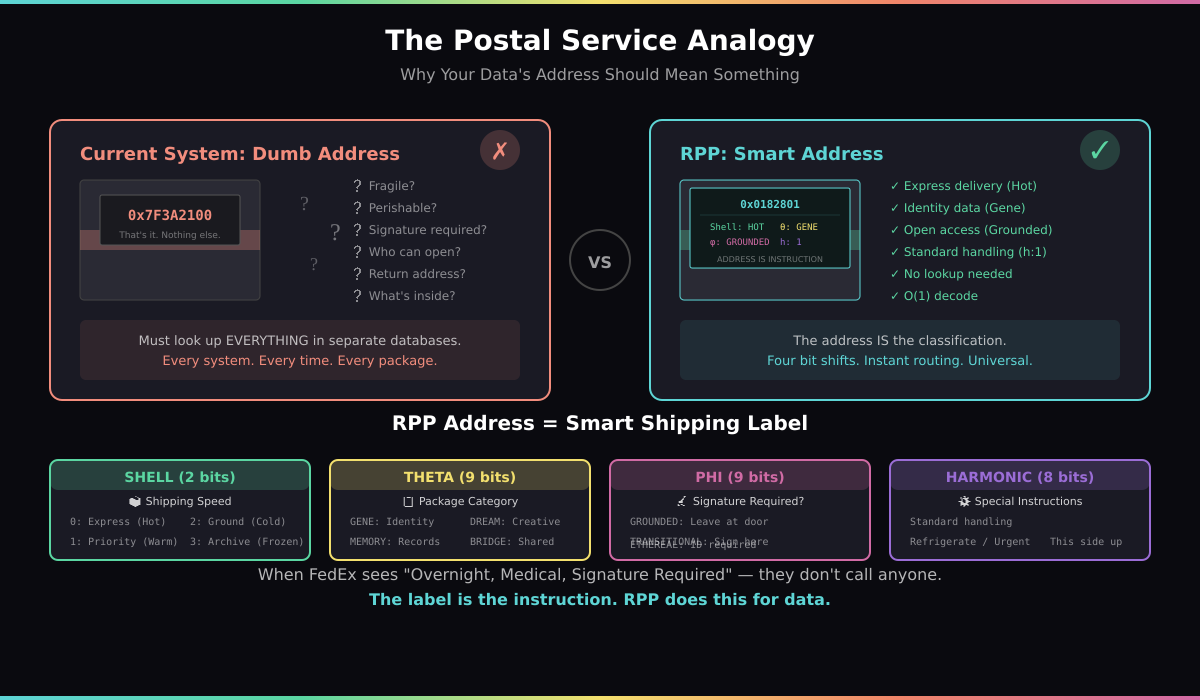
The Problem with Dumb Addresses
Imagine if postal addresses worked like computer memory addresses:
Send this to: 0x7F3A2100
That's it. No city. No country. No name. No indication of what's inside or how to handle it.
Now imagine you're a mail carrier. You receive a package labeled only "0x7F3A2100". Is it fragile? Perishable? Signature required? Who can open it? You'd need to look it up in a separate database. For every single package. Every single time.
RPP: Smart Shipping Labels for Data
A proper postal address carries meaning. From "FRAGILE - Dr. Jane Smith, MD, Cardiology Department, St. Mary's Hospital, 123 Medical Center Drive, Boston, MA 02115, USA" you immediately know handling instructions, recipient credentials, context, and routing path.
RPP gives data a proper address:
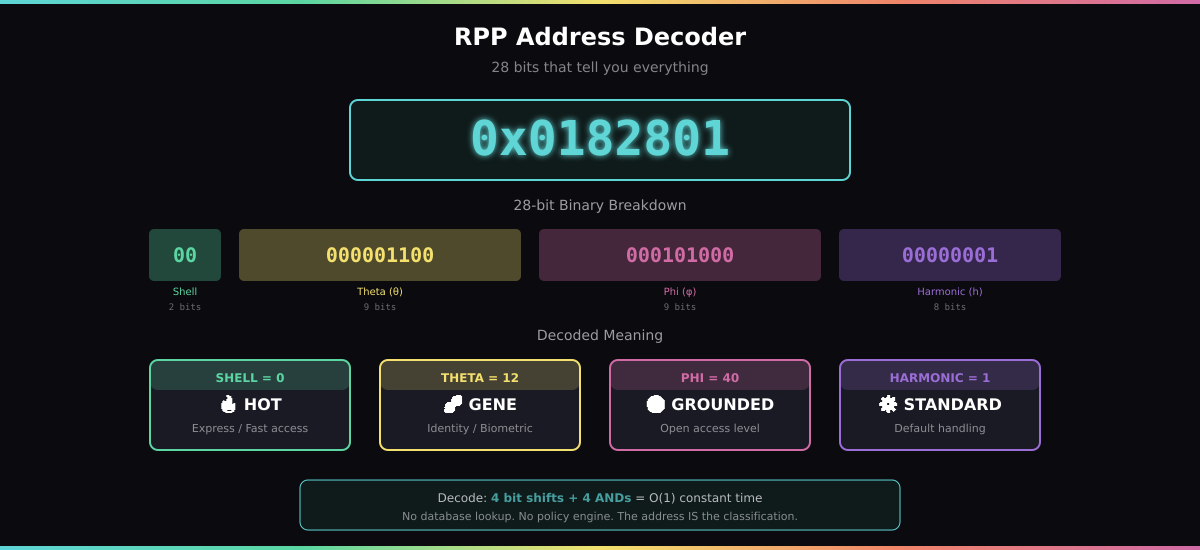
| Shipping Label | RPP Component | Meaning |
|---|---|---|
| Shipping Speed | Shell (2 bits) | Express (Hot) / Priority (Warm) / Ground (Cold) / Archive (Frozen) |
| Package Category | Theta (9 bits) | Documents / Medical / Hazmat / Perishable / Fragile |
| Signature Required? | Phi (9 bits) | Leave at door / Sign required / ID verification / Recipient only |
| Special Instructions | Harmonic (8 bits) | Standard / Refrigerate / This side up / Open immediately |
"When FedEx sees 'Overnight, Medical, Signature Required, Refrigerate'—they don't need to call anyone. The label is the instruction. RPP does this for data."
Case Studies
Healthcare Data Sharing
Sarah has a chronic condition. Her data exists in 7+ disconnected systems: primary care EMR, specialist system, hospital records, pharmacy, insurance, fitness tracker, mental health app.
The problem: None talk to each other. New doctor = same forms again. Emergency? Critical info locked away. And Sarah can't revoke access—consent forms from years ago last forever.
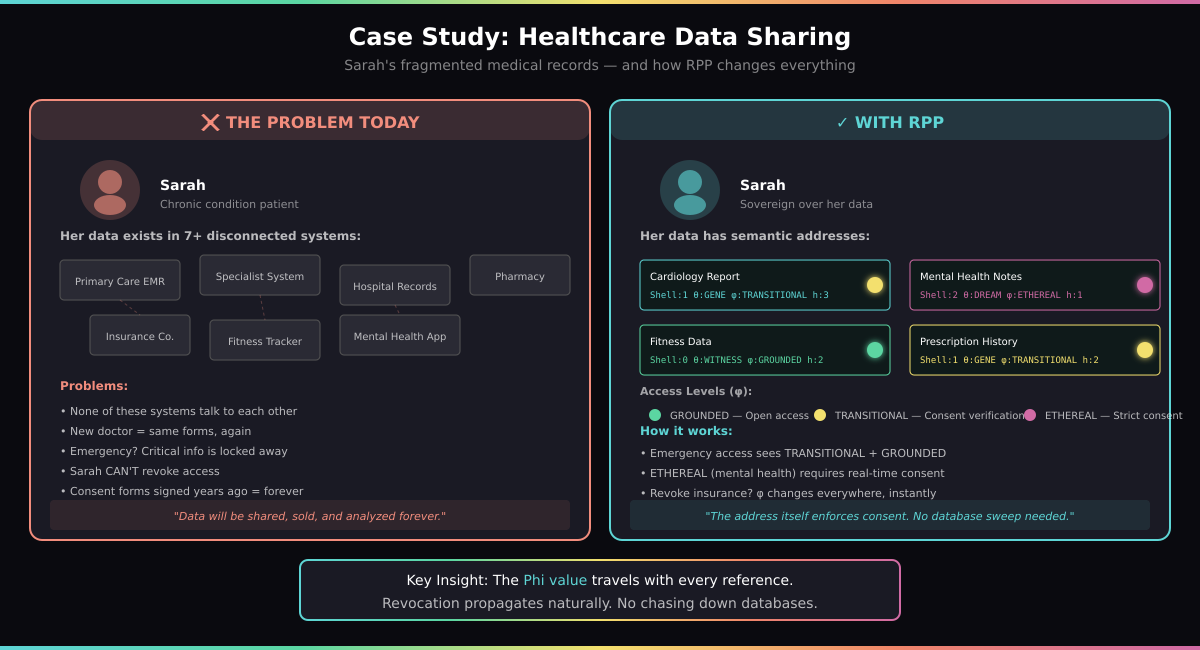
With RPP: Sarah's health data has semantic addresses. The Phi value travels with every reference. Emergency access sees TRANSITIONAL and GROUNDED data. ETHEREAL (mental health) requires explicit real-time consent. When Sarah revokes consent for her insurance company, the Phi value changes—everywhere, instantly.
AI Agent Acting on Your Behalf
You set up an AI assistant to manage your email. It has access to everything. It doesn't know which emails are sensitive, when you're in a good state to receive bad news, which contacts require personal responses, or when to slow down.
With RPP: Your AI agent operates through RPP-addressed references. Work emails from boss: TRANSITIONAL (delays when you're stressed). Family messages: ETHEREAL (never automated responses). Newsletters: GROUNDED (full automation allowed).
When your state shows elevated stress: GROUNDED items process normally, TRANSITIONAL items queue for later, ETHEREAL items are held until you explicitly request them. The agent can't violate consent because consent is in the address.
Domain-Specific Translations
How to explain RPP to different audiences:
🩺 For Healthcare Professionals
"RPP is like a universal patient wristband that travels with every piece of health data. Instead of checking permissions in five different systems, the data itself says who can see it. When a patient revokes consent, it's like the wristband changing color—every system sees it immediately."
⚖️ For Lawyers/Compliance
"RPP creates an auditable chain of custody for consent. The address is cryptographically linked to consent state at any moment. Instead of arguing about what someone agreed to, you can mathematically prove what the consent status was when data was accessed. Consent with receipts."
👨👩👧 For Parents
"You know how you tell your kids different things can be shared with different people? Some photos are okay for grandma, some just for family, some private. RPP lets you put that rule ON the photo itself, so it travels with the photo everywhere. If someone tries to share it wrong, the photo itself says no."
👩💻 For Engineers
"RPP is a 28-bit semantic address that encodes storage tier, data classification, access level, and handling mode directly into the address space. O(1) encode/decode. No external lookups. The address IS the ACL. It's like if DNS, RBAC, and content classification had a baby that fit in 4 bytes."
💼 For Business Executives
"Every year you spend millions on consent management, access control, and compliance systems—all because addresses are dumb. RPP makes addresses smart. The ROI is eliminating entire categories of infrastructure while getting better compliance. It's not a product you buy; it's a layer that makes everything else cheaper."
🔒 For Privacy Advocates
"RPP shifts power from platforms to people. When consent is encoded in the address, revocation is universal and instant. Platforms can't claim they 'didn't know'—the address told them. It makes consent violations provable and consent itself portable."
The Deeper Philosophy
From "Where Does It Go?" to "Where Does It Belong?"
Traditional systems ask: Where should I put this data?
This is a storage question. It optimizes for efficiency, retrieval speed, cost.
RPP asks: Where does this data belong?
This is a sovereignty question. It optimizes for consent, coherence, and rightful relationship.
Consent as Continuous, Not Binary
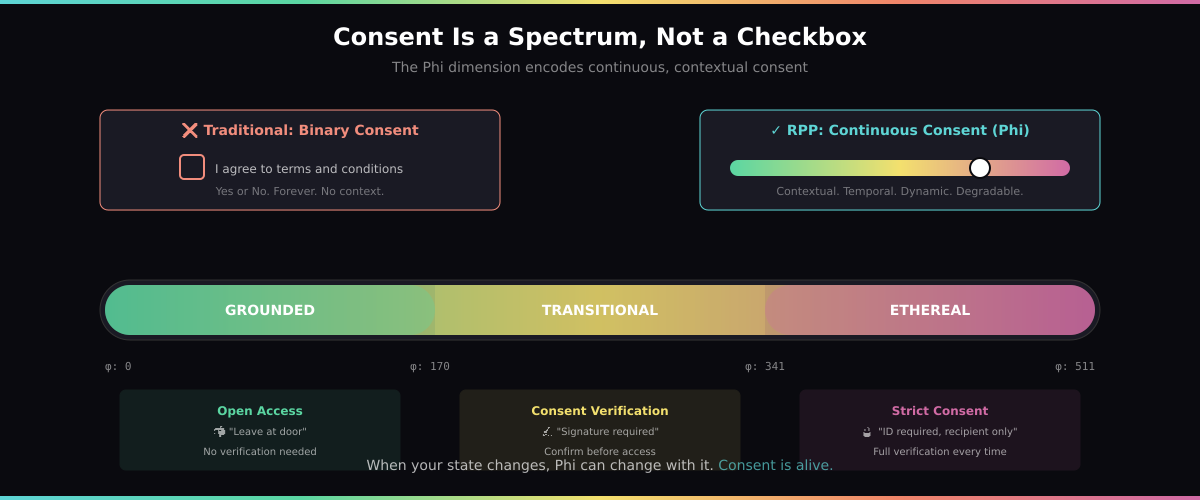
The checkbox model assumes consent is a moment: you agreed or you didn't. But consent is actually a state that varies across time, context, condition, and relationship.
RPP's Phi dimension encodes this continuous, contextual nature of consent. It's not yes/no—it's a spectrum with semantic meaning at every point.
Why Open Source?
A consent-based system cannot be coercively owned.
If Anywave controlled RPP, we could revoke access, change the rules, extract rent. That would violate the very premise of the architecture. RPP is open because consent must be open. The infrastructure of sovereignty cannot be proprietary. This isn't altruism. It's coherence.